
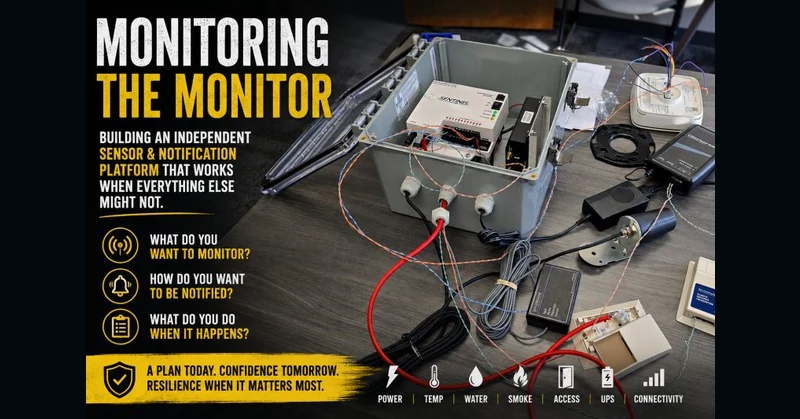
That sounds obvious.
But many organizations unknowingly build monitoring solutions that rely on the same power, network, internet, and infrastructure they are supposed to monitor.
That creates a dangerous blind spot.
If your primary environment fails, your alerting platform may fail with it.
No power. No network. No email. No monitoring. No alert.
That is exactly when visibility matters most.
Lately, I have been thinking about independent monitoring and notification platforms for critical environments like datacenters, network closets, MDFs, IDFs, and server rooms.
Not just sensors. Not just alerts. A complete response strategy.
An effective solution should answer three questions.
- What are we monitoring?
Common examples include:
Power loss Battery backup status Temperature Humidity Water detection Smoke detection Physical intrusion Connectivity loss UPS runtime remaining
The goal is not to monitor everything.
The goal is to monitor what creates operational risk.
What failures could cause downtime, equipment damage, data loss, or major business impact?
Those deserve priority.
- How do we want to be notified?
This is where many teams stop.
They configure alerts and call it done.
Email works, until email is unavailable.
Critical monitoring often needs independent communication paths:
Cellular Phone calls SMS Push notifications Escalation paths
Because an alert no one sees is useless.
Who gets notified first? Who gets notified next? When does leadership get involved?
Those decisions should be made before the crisis.
- What happens next?
This is the most important question.
An alert without a response plan only creates awareness.
It does not create action.
What happens when an alarm triggers at 2:13 AM on a Saturday?
Can it wait until business hours?
Does someone need to respond immediately?
Who is authorized to make time-sensitive decisions?
Imagine commercial power fails.
Your datacenter shifts to battery backup, but generator support fails.
Now the clock is ticking.
Who makes the call?
Who can initiate emergency shutdown procedures?
Which systems stay online the longest?
These are business continuity questions as much as technology questions.
The sensors matter. The alerts matter. But process and decision-making matter even more.
Monitoring should not only tell us something is wrong.
It should help us respond with speed, clarity, and confidence.
That is where resilience is built.
How is your organization handling critical monitoring and after-hours