
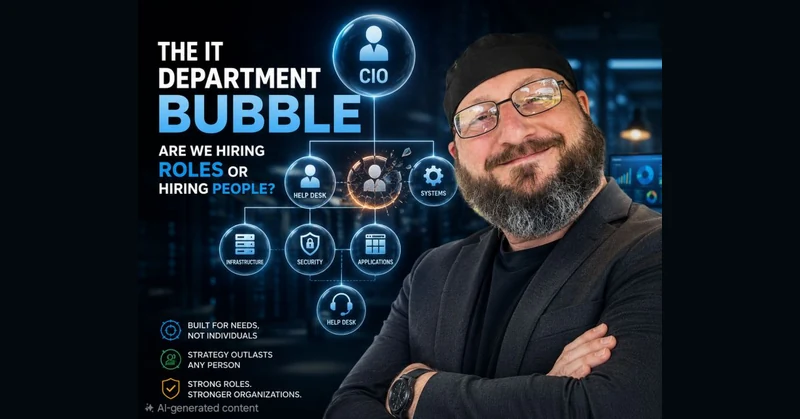
Lately, I’ve been thinking about something I’ve seen happen across IT organizations in both private and public sectors.
I call it the IT Department Bubble.
The bubble forms when organizations begin building roles around specific individuals instead of building roles around long-term business and operational needs.
At first, this may seem harmless.
A strong leader emerges. A talented engineer proves invaluable. A highly skilled administrator becomes the person everyone depends on.
Over time, responsibilities grow around that individual. Titles evolve. Reporting structures shift. Decisions get made based on the strengths of a person rather than the strategic needs of the organization.
Eventually, the role and the person become difficult to separate.
That is where risk begins.
We see it in many forms.
An organization creates a leadership role because they have the perfect candidate in mind.
A CIO leaves, and suddenly leadership asks if the role really needs executive-level authority. The position gets reclassified to a Director role and moved out of executive leadership.
A senior engineer retires, and instead of replacing the role, the organization hires a lower-level position to reduce cost.
A technical expert leaves, and leadership realizes years of institutional knowledge walked out the door with them.
The bubble pops when the person leaves.
And sooner or later, everyone leaves.
Retirement. Promotion. Resignation. Career changes. Life happens.
That’s when the real questions surface.
Did the role exist because the organization truly needed it? Or did the role exist because one person made it valuable?
Was the position strategic? Or was it built around a specific personality, skillset, or relationship?
This is why succession planning and organizational design matter so much in IT.
Strong organizations do not build departments around individuals.
They build departments around capabilities.
They ask: What business problem does this role solve? What operational function does it support? What risk is introduced if this position disappears? Can someone else realistically step into this role?
The goal is not to diminish the value of great people.
Great people absolutely transform organizations.
But mature leadership understands something important:
You cannot build sustainable IT strategy around individuals alone.
You have to build systems, processes, structure, and roles that can survive leadership transitions and staffing changes.
Because if losing one person creates organizational instability, the real issue was never the departure.
The issue was dependency.
As leaders, we should challenge ourselves to ask:
If a key person left tomorrow, are we replacing a strategic role... or trying to recreate a person?
That answer says a lot about the health of an IT organization.