
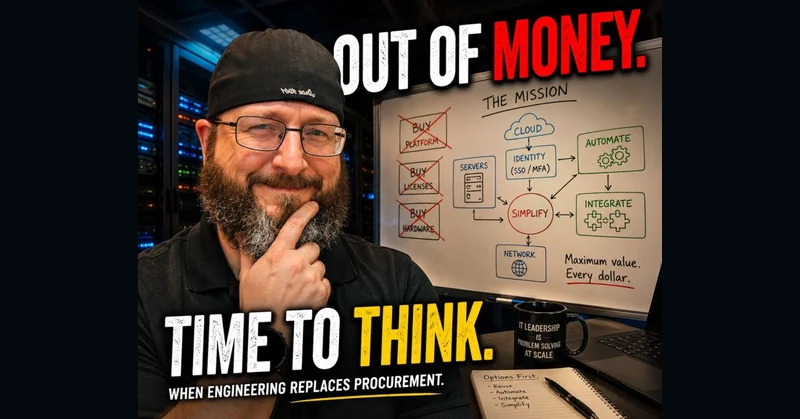
“We are out of money. Now we need to think.”
I keep coming back to that phrase because there is a surprisingly good IT leadership lesson buried inside it.
When money is available, it is easy for purchasing to become the answer to every technology problem.
Need a capability? Buy another platform.
Need more capacity? Buy more infrastructure.
Have a process problem? Find a product that promises to fix it.
Sometimes buying something really is the right answer. But having money can also allow us to postpone asking harder questions.
What problem are we actually trying to solve?
What capabilities do we already own?
Are we paying for multiple products that overlap?
Could we automate part of the process?
Could we change the workflow instead of buying technology to support an inefficient one?
Is something truly a requirement, or is it simply how we have always done it?
When the checkbook is removed from the conversation, something interesting happens.
Engineering starts replacing procurement.
I think IT leaders should occasionally create that constraint even when the organization isn't actually out of money.
Before approving the next major purchase, ask:
“Assume there is no money for this. How would we solve it?”
Maybe the team comes back and says there isn't a responsible alternative. Perfect. Now we have a much stronger justification for making the investment.
But sometimes the answer is:
“We already own most of what we need. We just never thought about putting the pieces together this way.”
That is the kind of thinking I want technology teams to develop.
This isn't about being cheap. Cheap technology decisions can create technical debt, security risks, operational headaches, and much larger expenses later.
It is about stewardship.
Especially in public-sector IT, our responsibility isn't simply to spend less.
It is to create the greatest mission value we can from every dollar entrusted to us.
We shouldn't have to run out of money before we start thinking like we're out of money.