
One of the most important skills in IT leadership has nothing to do with technology.
It’s learning how to talk about technology to people who don’t live in our world.
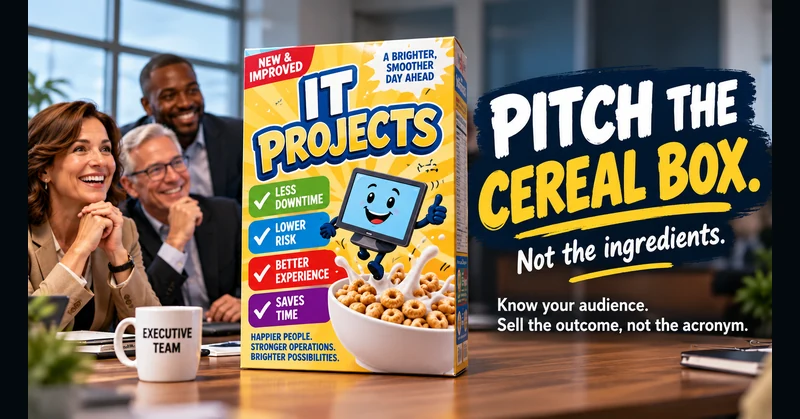
Think about a box of cereal.
When you walk down the grocery aisle, the front of the box doesn’t lead with a paragraph explaining every ingredient, how the cereal was manufactured, what equipment was used, or the chemistry behind preserving it.
That information matters. It’s there if you want it.
But it’s not the pitch.
The front of the box tells you what matters to the customer:
Heart healthy. High in fiber. Great taste. Start your day right.
Then we walk into an executive meeting and do the exact opposite.
We start talking about zero trust, conditional access, self-healing endpoints, SSO, APIs, VLANs, MFA, EDR, cloud architecture, AI models, and a bowl full of alphabet soup.
We’re proudly reading the ingredients.
Meanwhile, the people across the table may be thinking:
What problem are we solving?
How does this help our students or employees?
Does this reduce risk?
Does it save time or money?
What happens if we don’t do it?
And why should this be a priority right now?
That’s the front of the cereal box.
I’ve learned that a technically impressive presentation isn’t necessarily an effective presentation.
If I’m sitting with engineers, network administrators, or security professionals, absolutely, turn the box around. Let’s read the ingredients. Let’s talk architecture, integrations, protocols, dependencies, controls, and implementation.
But when I’m talking with a president, CFO, faculty member, department head, board member, or other stakeholder, they shouldn’t need an IT degree to understand why an IT project matters.
That isn’t “dumbing it down.”
That’s knowing your audience.
As IT professionals, we sometimes feel like explaining all the technical complexity demonstrates the value of what we do.
Sometimes it does the opposite.
The real value may be that employees can work securely from anywhere.
The value may be that a compromised password no longer gives someone the keys to the kingdom.
The value may be that a classroom fixes itself before an instructor ever has to call the help desk.
The value may be that something which took an employee 30 minutes every morning now happens automatically.
Those are outcomes.
Those belong on the front of the box.
The self-healing technology, automation, security controls, integrations, infrastructure, and acronyms that make it possible?
Those are the ingredients.
A good IT professional understands the ingredients.
A good IT leader also knows which side of the box to show.