
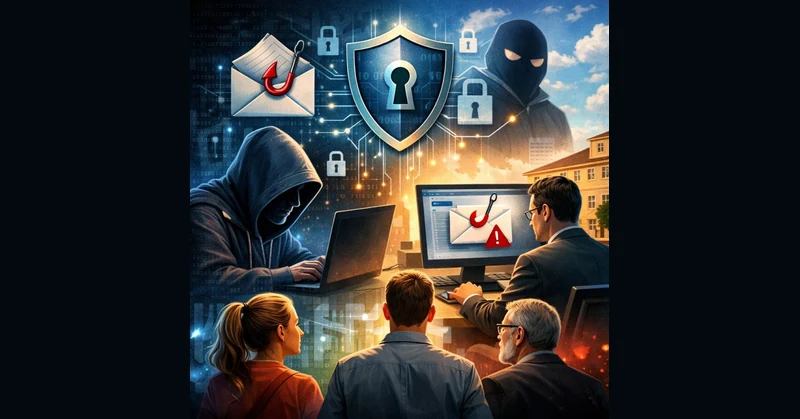
Today I had the opportunity to stand on stage and talk about email security. One idea kept coming back throughout the conversation.
Cybersecurity is no longer just the responsibility of the IT department.
In many ways, everyone in the organization is now part of the IT department.
Over the years we have invested heavily in security systems. Email filtering platforms. Threat intelligence. Endpoint protection. Multi factor authentication. Monitoring tools that detect suspicious activity before it spreads across a network.
These tools are essential. They block an incredible amount of malicious activity every single day.
But attackers have figured something out.
Breaking technology is hard. Breaking people is easier.
Instead of trying to bypass hardened security systems, many attackers focus on the path of least resistance. They send thousands of phishing emails hoping that a small number of people will respond to the urgency in the message and take action.
It becomes a return on effort calculation.
Why spend weeks attempting to exploit a system when a single convincing email with a strong call to action might accomplish the same goal?
Attackers also use clever techniques to refine their targeting. Something as simple as an embedded image in an email can tell a remote server whether a mailbox is active. Those images often contain uniquely hashed filenames. When the email loads, the attacker learns that the account is real and becomes a higher value target for future campaigns.
Even strong security controls depend on human decisions.
Multi factor authentication has dramatically improved security across organizations, but we also see the rise of MFA fatigue. Repeated approval prompts can lead to frustration or confusion, and attackers hope that eventually someone clicks approve without realizing what they are authorizing.
This is why security awareness matters so much.
Every person who opens email, clicks links, downloads files, or approves a login request plays a role in protecting the organization. Cybersecurity today is not just infrastructure and software. It is behavior, awareness, and culture.
Technology teams build the systems. But people strengthen the defense.
So I will leave a few questions for discussion.
Have you ever received a phishing email that looked convincing at first glance? What helped you recognize that something was not right? What habits have you developed to stay safe online?
In today’s environment, cybersecurity works best when everyone understands they have a role to play.
In many ways, we are all part of the IT department now.