
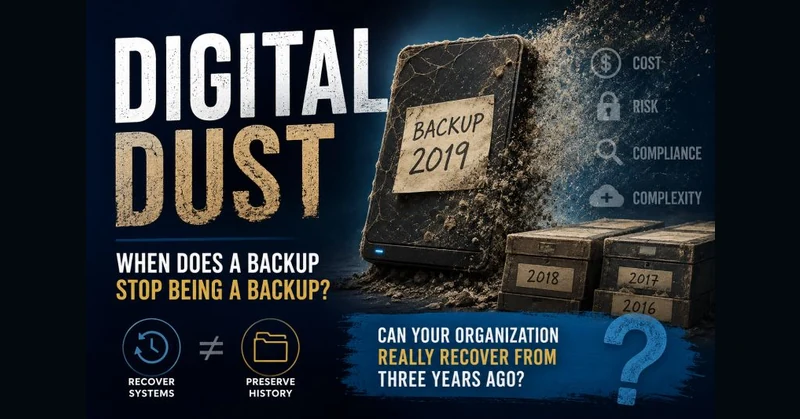
I've been thinking about a term I recently heard: digital dust.
It's the data we continue to keep because nobody has decided whether it still has value.
As IT leaders, we're often asked, "How long should we retain backups?" The discussion usually turns into storage costs, licensing, or cloud pricing. Those are important considerations, but I don't think they're the first question we should ask.
Instead, I think we should ask:
What business problem are we trying to solve by keeping this backup?
Everyone can come up with a scenario.
"What if ransomware sat dormant for years?"
"What if we need to recover something from three years ago?"
Those are valid questions, but here's the one I struggle with:
Could your organization actually operate if IT restored your environment from three years ago?
Think about everything that has changed. Systems have been upgraded. Employees have come and gone. Policies have evolved. Vendors have changed. Data has continued to grow.
At what point does restoring an old backup become less practical than rebuilding or recovering through other means?
Maybe backups and archives are conversations we should stop combining. One is designed to recover systems. The other is designed to preserve history.
I'm not claiming to have the perfect answer. I'm genuinely curious how others approach this.
How does your organization determine when a backup has become digital dust? Is it based on risk, compliance, business value, or simply available storage?
I'd love to hear how other IT leaders are having this conversation with their stakeholders.