
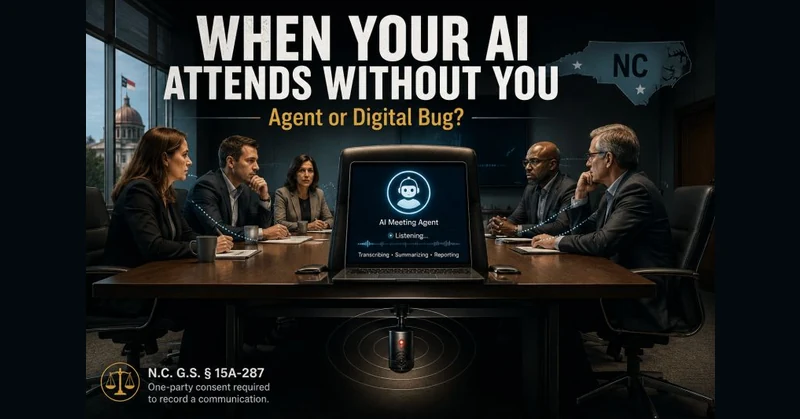
North Carolina’s one-party consent law creates an interesting question as AI agents become capable of doing more than simply joining meetings as obvious bots. Consider a scenario where an AI agent is operating through my own account, identity, and credentials on my behalf. On the meeting roster, it may appear that I am attending, but I am not actually there. The AI is listening, processing the conversation, taking notes, creating a transcript or summary, and reporting back to me afterward.
Traditionally, I can record a meeting I am attending because I am a party to that conversation and can provide the required consent. But consider the low-tech equivalent: I place a recording device in a conference room, turn it on, and leave before the meeting begins. The fact that I own and activated the device does not make me a participant in the conversation it captures. An autonomous AI operating under my digital identity raises a remarkably similar question. Does an AI using my account actually make me a party to the communication, or have I simply created a much more sophisticated digital recording device that happens to have my name on it?
That distinction becomes even more important as AI agents gain the ability to speak, respond to questions, take actions, and increasingly impersonate the presence of the person they represent. Technology may soon make it difficult for other participants to even recognize whether they are meeting with a person or that person's autonomous agent.
This is where technology is moving faster than the laws and policies written to govern it. Organizations should be thinking now about AI identity, disclosure, consent, recording, retention, and governance rather than waiting until autonomous agents become commonplace.
And the consequences are potentially much greater than a policy violation. Under North Carolina G.S. § 15A-287, willfully intercepting a communication without the consent of at least one party can constitute a Class H felony. Until North Carolina law or the courts provide clearer guidance on whether an autonomous AI operating under someone's identity can itself qualify as a party to a communication, that is a significant amount of legal uncertainty hiding behind a seemingly simple “have my AI attend for me” button.