
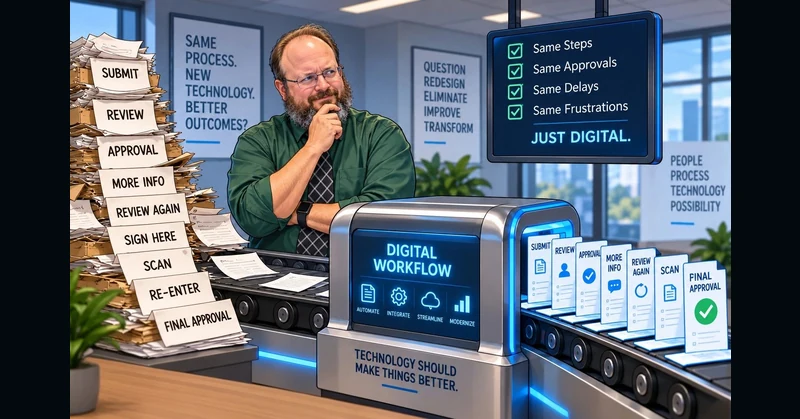
There is a big difference between digitization and transformation.
Sometimes an organization takes a process that has existed for years, moves the form online, adds an electronic approval workflow, sends some automated notifications, and calls it digital transformation.
But did we actually make the process better?
Or did we just make the old process electronic?
That distinction matters.
Technology is very good at making things happen faster. Unfortunately, that includes bad processes.
If a process has unnecessary approvals, redundant data entry, confusing ownership, outdated requirements, or steps that exist simply because "that's how we've always done it," automating those steps doesn't necessarily solve the problem.
It may just allow us to execute the same bad process more efficiently.
Before we start building workflows and integrations, there are some harder questions worth asking:
Why does this process exist?
Why does it have these particular steps?
Who actually needs to approve this?
What information do we truly need to collect?
Are two departments collecting the same information?
Is someone manually entering information that already exists somewhere else?
Does this requirement still serve a purpose, or has everyone simply forgotten why it was created?
And one of my favorites:
Could we eliminate this step instead of automating it?
Those aren't really technology questions.
They're leadership and process questions.
This is also why I think some modernization projects miss an enormous opportunity.
Replacing an aging system gives an organization a rare chance to examine how work actually gets done. Yet it is incredibly easy to approach implementation by saying:
"Here's what the old system does. Make the new system do the same thing."
Sometimes that's necessary.
But sometimes we're spending significant time and money teaching a modern platform how to reproduce twenty years of accumulated processes, exceptions, workarounds, and organizational habits.
Then we wonder why the new system still feels complicated.
Digital transformation shouldn't mean recreating the past with newer technology.
Sometimes transformation means automation.
Sometimes it means integration.
Sometimes it means redesigning the entire workflow.
And sometimes the most innovative thing technology leaders can recommend is surprisingly simple:
Stop doing something that no longer needs to be done.
Before asking how technology can automate a process, maybe the first question should be whether that process deserves to survive unchanged.