
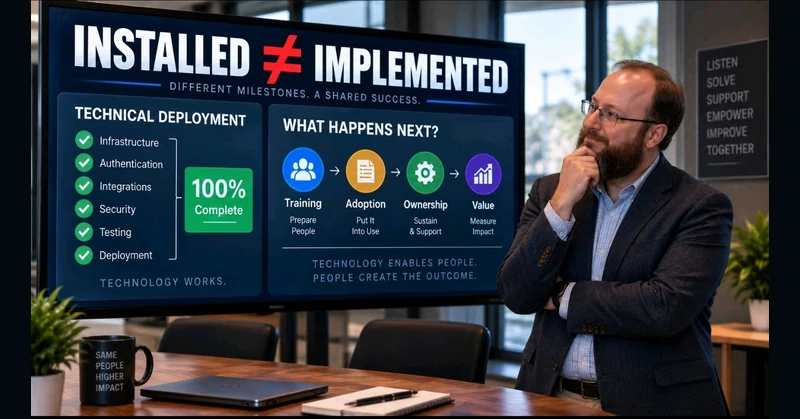
One lesson from my CGCIO journey has made me rethink what it means to call a technology project “complete.”
Installed is not the same as implemented.
I've seen this cycle more than once in IT.
A request comes in for a new system, service, or integration. IT gets to work. We build the infrastructure, configure authentication, work through integrations, address security requirements, test everything, document our part, and eventually reach the point where we can say:
"It works."
Then things get quiet.
Months later, the conversation starts again.
“We're ready to start using that system.”
From the technical side, the project may have been completed months ago. From the organization's perspective, the project is just beginning.
That gap is where I've started paying more attention.
Who was responsible for training the users? Who communicated the change? Were business processes updated? Was there an adoption plan? Who owns the service after implementation? How are we measuring whether the technology actually solved the problem that justified purchasing or building it in the first place?
Those aren't just questions for the department requesting the technology. They're questions IT leadership should be asking before the first server is built or the first configuration is changed.
A successful deployment proves that the technology works.
A successful implementation proves that the organization can use it.
And a successful technology investment should eventually prove something even more important: that it created the value we expected when we decided to do it.
That's a distinction I'm taking away from CGCIO and applying to how I think about projects going forward.
Maybe “project complete” shouldn't mean the technology is ready.
Maybe it should mean the organization is ready too.