
It Started With a Discord Webhook...
Some of my favorite technology projects don't happen during the workday.
Outside of work, I'm part of a military simulation (Milsim) community that enjoys cooperative storytelling, teamwork, and creating immersive experiences around a game. What started as "making Discord a little smarter" turned into a full technology ecosystem.
It started with a simple question: What if game events didn't just stay in the game?
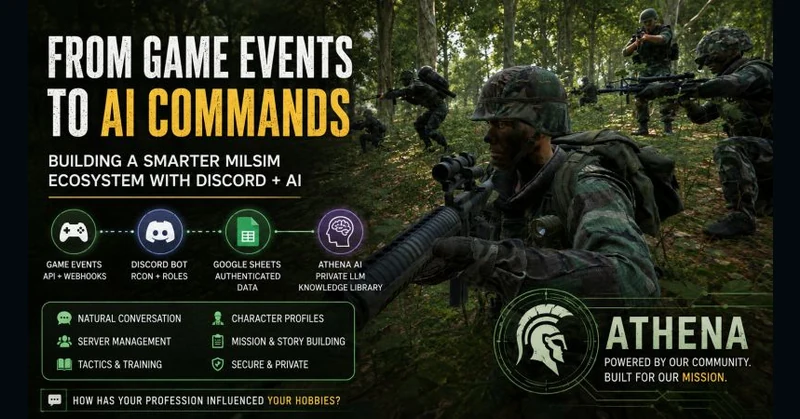
We built a private API that receives game events, processes them, formats them, and publishes them into Discord through webhooks. Suddenly, mission events became searchable, readable, and available to everyone in real time.
That naturally led to the next question.
If we can send information out of the game, why can't we send commands back?
So we built a custom Discord bot that securely communicates with the game server through Remote Console (RCON). Using role-based permissions, authorized leaders can manage the server, send messages, retrieve information, and perform administrative tasks without ever leaving Discord.
Then our attention shifted to data.
We wanted resources, rosters, and reference material to be easy to maintain without touching code. We integrated authenticated Google Sheets using JSON service account credentials, allowing trusted administrators to update information while the bot instantly consumed the latest data.
But even with all of that, interacting with the system still felt... robotic.
So we built Athena.
Athena is a privately hosted Large Language Model (LLM) running entirely on our own infrastructure. It has no public internet access and doesn't share conversations externally. Instead, it focuses on the knowledge we've chosen to give it.
Now members can simply talk naturally inside Discord.
Instead of memorizing commands or syntax, they can ask questions in plain English.
Athena can retrieve unit information, assist with server management, help develop realistic mission concepts, generate character biographies and backstories, explain real-world tactics, and serve as a growing knowledge library for our community.
Looking back, it's interesting how one small automation evolved into APIs, webhooks, authenticated data services, role-based security, artificial intelligence, and natural language interfaces.
Sometimes our hobbies become the best playground for learning new technologies before we ever bring those ideas into our professional careers.
I'm curious...
How has your profession started to influence your hobbies, or vice versa? Have you ever built something "just for fun" that ended up teaching you skills you now use professionally?