
There are two professional habits I have been thinking about lately, and I believe they are closely related.
The first is being comfortable saying:
"I don't know, but I'll find out."
I would rather hear that every single time than receive an answer delivered with confidence that hasn't actually been verified.
Nobody knows everything. Technology is too broad, changes too quickly, and touches too many systems for any of us to have every answer.
Not knowing isn't a weakness.
The important skill is knowing the difference between what you know, what you think, and what you still need to verify.
The second habit is how we escalate problems.
I absolutely want people to raise issues. Never hide a problem simply because you don't know how to fix it.
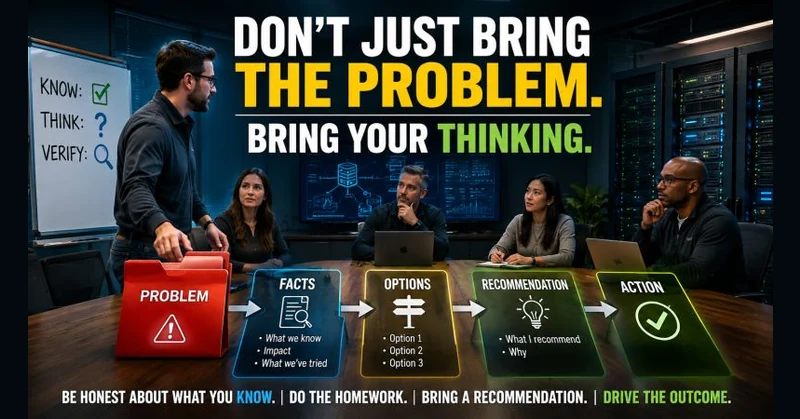
But when possible, don't just bring the problem. Bring your thinking.
A useful escalation can be surprisingly simple:
FACTS: What do we actually know? What is the impact? What have we already tried?
OPTIONS: What are some possible ways forward?
RECOMMENDATION: Based on what you know, what do you think we should do?
ACTION: What decision, resource, access, or assistance do you need to move forward?
You don't have to be the person capable of implementing the solution. You may not have the authority, budget, access, or technical expertise to fix it yourself.
Your recommendation might even be wrong.
That's okay.
I'd much rather discuss an imperfect recommendation than start from an awkward pause after hearing, "We have a problem."
And sometimes the recommendation is simply:
"I don't know yet. I need more time to research this before I can recommend what we should do."
That's a perfectly reasonable answer too.
The goal isn't to create a culture where people are afraid to bring leadership bad news. It's the opposite. Bring problems forward early.
But whenever circumstances allow, bring some thought with them.
Know what you know. Admit what you don't. Do the homework. Develop an opinion. Bring a recommendation.
That's how identifying a problem starts becoming ownership of an outcome.