
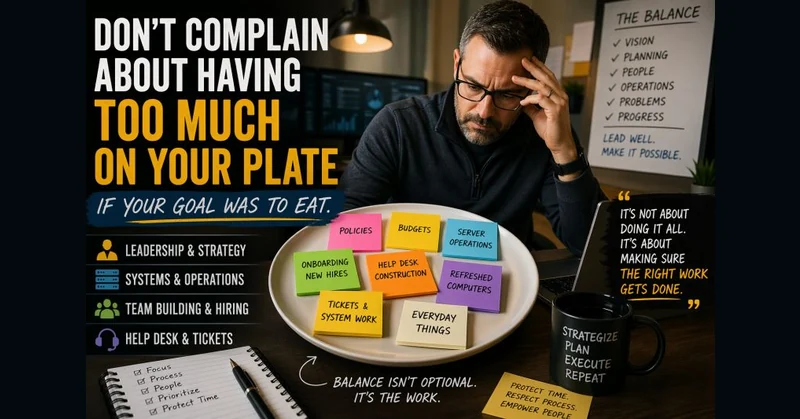
That line has been sitting with me lately, and it reflects the reality of IT leadership more than people realize.
As an IT Director, the day doesn’t stay in one lane. It’s budgets, policies, vendor conversations, onboarding new hires, planning a help desk space, refreshing systems, and keeping the environment stable and secure.
It’s strategy layered on top of operations. And then there’s the work that never really goes away.
The tickets. The systems. The troubleshooting that requires quiet time and focus.
Most of that doesn’t happen during the day. It happens after the day is already full. That’s the part people don’t always see. The role doesn’t replace the work. It adds to it. So the challenge isn’t just workload. It’s balance.
Balancing leadership with execution. Balancing long-term vision with immediate needs.
Balancing interruptions with the people who followed process and respected your time. If you’re not intentional, you become your own bottleneck.
Those “this won’t take long” moments add up fast. Before you know it, the work that requires real focus gets pushed out, and everything starts to feel overwhelming.
It’s not about ignoring people. It’s about leading with discipline.
Reinforcing process. Encouraging tickets. Protecting time for deep work. And being honest about something else. You can’t do it all yourself.
You make things possible by surrounding yourself with people who can do the work. That means hiring for capability and accountability, not just connection.
Culture matters. But execution matters too. I chose this role. I wanted the plate. So the responsibility isn’t to complain about how full it is. It’s to carry it well and not get in your own way or your team’s.
I’m curious how others are handling this. How do you balance leadership responsibilities while staying close enough to the work to lead effectively?
How do you manage interruptions without losing focus on what actually matters?