
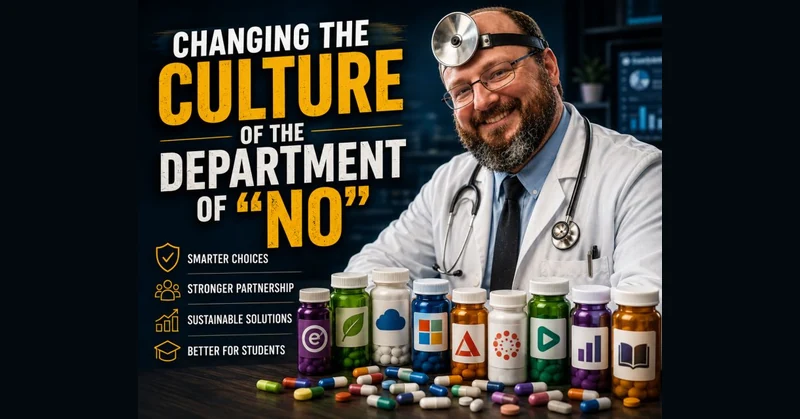
If you've worked in higher education long enough, you've probably heard IT described as the "Department of No."
I understand why that perception exists.
Faculty are constantly discovering new ways to teach, collaborate, and engage students. Innovation should be encouraged.
But innovation also needs stewardship.
Every technology decision should answer one question:
Does this help us better serve students, not just today, but sustainably for years to come?
Every application we officially support becomes a long-term commitment. It's more than a license. It's cybersecurity, accessibility, privacy, integration, documentation, training, maintenance, and support.
Over time, departments naturally discover different tools that solve the same problem. Individually, those decisions make sense. Collectively, they create an environment that's difficult to support.
Imagine expecting a help desk analyst to become proficient in five survey platforms, four project management tools, three video conferencing solutions, and multiple AI applications that all accomplish nearly the same task.
It's simply not sustainable.
I believe institutions should evaluate technology collaboratively and, where practical, standardize on a primary supported solution with a secondary option for specialized needs. That allows IT to provide better training, stronger security, and more consistent support while still giving faculty a voice in the process.
This isn't about saying "no."
It's about saying, "Let's find the best solution for the institution."
Good governance doesn't limit innovation.
It makes innovation sustainable.
Because innovation without governance creates complexity.
And governance without innovation creates stagnation.