
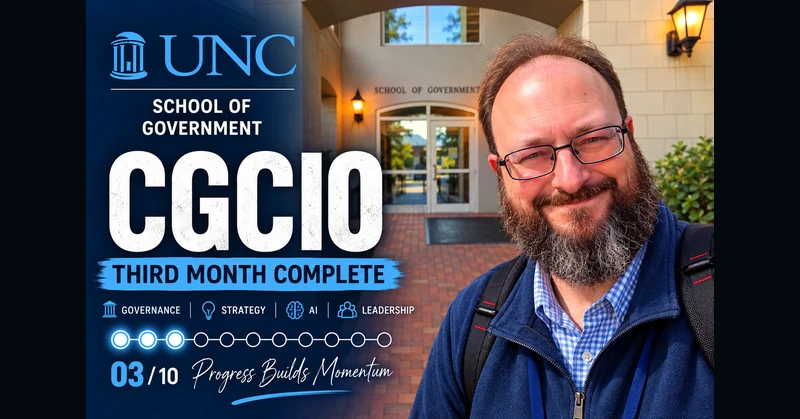
Three months down, seven to go!
Just completed my third month of the North Carolina Certified Government Chief Information Officer (CGCIO) program at the UNC School of Government.
This month's focus was IT governance, strategy, artificial intelligence, and personal leadership.
And one theme kept coming back throughout our discussions.
Being good at technology doesn't automatically make someone good at leading technology.
We explored why major technology projects fail, including lessons from the Healthcare.gov rollout.
It's easy to point fingers at the technology, vendors, or implementation teams when things go wrong.
But what about unclear expectations? Poor communication? Weak governance? Decisions made without the right people at the table?
Sometimes the biggest project risks aren't technical at all.
We also discussed governance and strategy, particularly how organizations make decisions and establish accountability.
Governance shouldn't exist just to create another committee, policy, or approval process.
Good governance helps the right people make informed decisions at the right time.
Then came artificial intelligence.
AI is moving faster than many organizations can develop policies around it.
So what do we do? Wait until we have the perfect policy?
That's not realistic.
Instead, we discussed practical AI governance, evaluating use cases, understanding risks, and establishing responsible boundaries without unnecessarily restricting innovation.
An AI policy shouldn't just be a list of things employees cannot do. It should help them understand what they can do responsibly.
Perhaps the most personally relevant discussion was about transitioning from the technical rescuer to the enterprise leader.
As IT professionals, many of us built our careers by being the person who could fix things.
The server is down? Fix it. The application isn't working? Troubleshoot it. Something breaks? Find a solution.
But leadership requires something different.
It means developing people, building trust, communicating value, and sometimes resisting the temptation to jump in and solve every problem yourself.
Your value as a leader isn't measured by how many problems you personally fix, but by how well you prepare your organization to solve them.
That one is worth reflecting on.
Three months into this program, I'm appreciating not only the material but also the conversations with fellow government technology leaders across North Carolina.
Different organizations, different challenges, but many of the same leadership lessons.
Seven months to go, and plenty more to learn.